The 35mm Work Book focuses on mastering a solid and repeatable technique. There is little mention of my personal approach to taking photos; rather, the emphasis is on recognising a potential image and composing it within the camera. I firmly believe that if photographers adhere to a consistent system when shooting, they will produce high-quality images that serve as excellent photographic records of events, places, or people.
Once the process is thoroughly mastered, it becomes an automatic extension of one’s artistic creativity. At this stage, the composition can be adapted, allowing the photographer to begin cultivating their unique photographic identity.
In this short essay, I present ideas for novice photographers to explore beyond the 35mm Work Book. We’ll focus on the 28mm lens, a favourite among many photographers for its ease of use and ability to produce excellent snapshots. The 28mm lens offers superb depth of field. By selecting an aperture of f/5.6 or f/8.0 (depending on the weather and brightness) and setting the distance to approximately 5 meters (16 feet), you can achieve outstanding imagery. Don’t worry too much about distant subjects with this focal length, as they tend to appear too small to be of significant importance.
I will use any camera; I have no interest in the ‘best’ or ‘better’ considerations. Although it is fair to say that auto-exposure cameras are excellent for snapshot or candid photography, I feel that composition takes precedence over all other considerations. And if the photographer is centred on composition and allows the camera to work its exposure magic, there will be a greater number of decent images on each roll of film.
Before reviewing the images, I’d like to discuss the project. I was unexpectedly given the chance to attend the Hunton Steam and Tractor Fair. Despite a poor weekend weather forecast, Saturday between 11:00 and 15:00 offered the best window. I now shoot exclusively with Ilford film for monochrome work and have plenty of Pan F, FP4 Plus, and HP5 Plus on hand, ultimately choosing HP5. The challenge was that I had planned another project for the weekend and was travelling light when it came to lenses. I only brought the 50mm Nikkor H and the 28mm Nikkor f/3.5. I really wished I’d also packed my 85mm f/1.8 on a second Nikon FE, as events like this are ideal for candid portraits, and the 85mm is my lens of choice for that. As a result, I shifted my focus to the purpose of this WordPress site: to document ideas and techniques from the 35mm Work Book.
The Nikon FE was loaded with HP5 Plus film and fitted with a 28mm lens for this roll. The meter was set to ISO 320. The film was developed in Ilford ID11 at a 1+3 dilution and processed at 20°C for 20 minutes.
The lens was set to f/5.6, and the focal point was adjusted to around 5 meters—approximately the hyperfocal distance. Of course, I tweaked the focus for some shots, but returned to the hyperfocal setting after making fine adjustments. The image of the boy driving the mini steam engine was captured as a snapshot. I really should have taken more photos of this great scene, but these days, people are more sensitive about photographing children, so I was pleased to get at least one good shot.
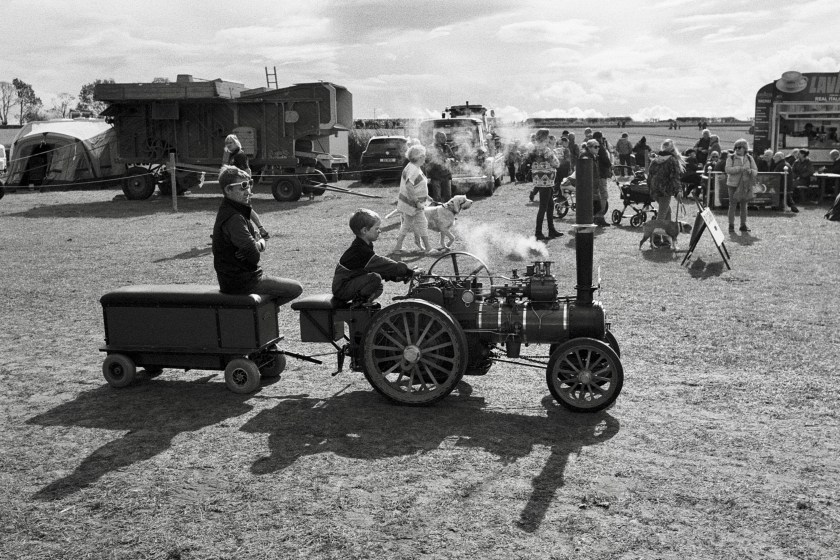
This is a great image. I was about 4 metres away, I put the camera to my eye, framed as quickly as possible and released the shutter. Look very carefully at the shadows, I’m taking the image into the sunlight. This is only possible to gain detail such as this at this time of the year, as the sun is very low. Usually, we would end with a silhouette. The latitude of the #Ilford HP5 Plus film is truly remarkable in this instance. By using the ID11 developer at a 1:3 compensating dilution, we end up with a very usable negative.
Now let’s look at a few portrait-framed images. I composed them to minimise distortion as much as possible, so you’ll notice a significant amount of wasted foreground. My goal is always to fill the negative space as much as possible. The outcome is a matter of personal preference: do we value distortion or prefer rectilinear framing? Again, it comes down to individual choice. Remember, the whole point of this exercise is to capture well-exposed, reasonably sharp images—nothing more.
Click any picture to enlarge the image and see the portrait view
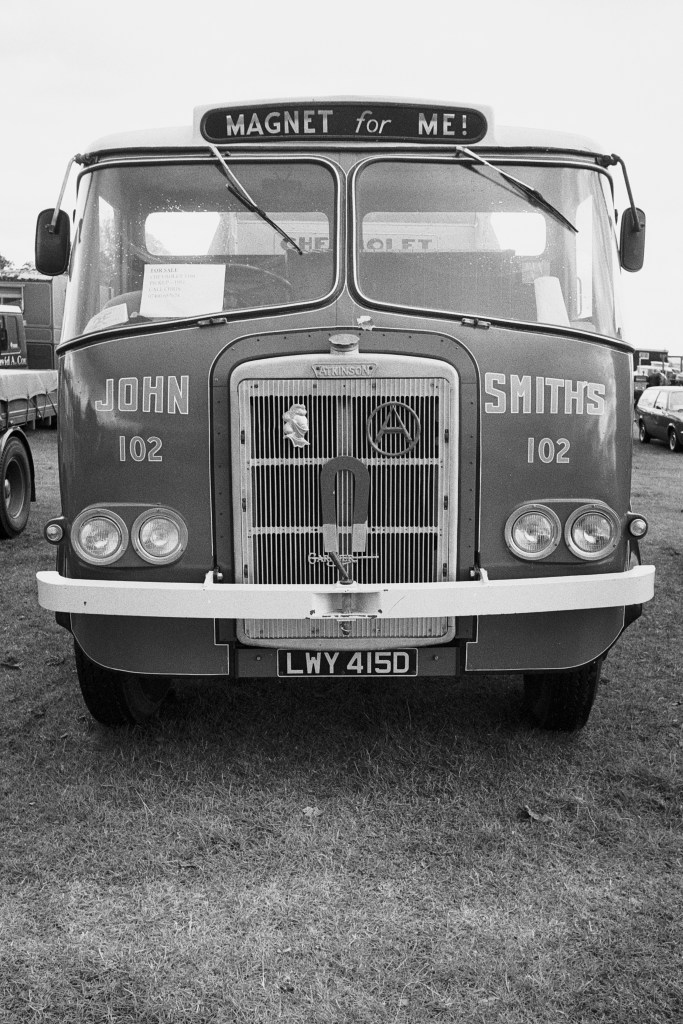
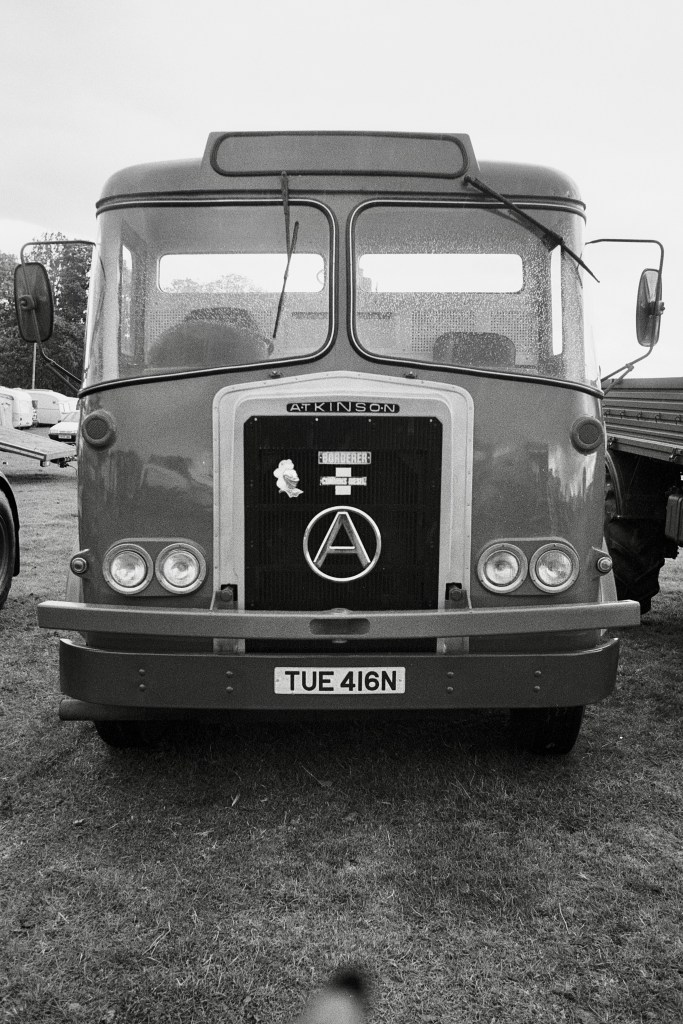
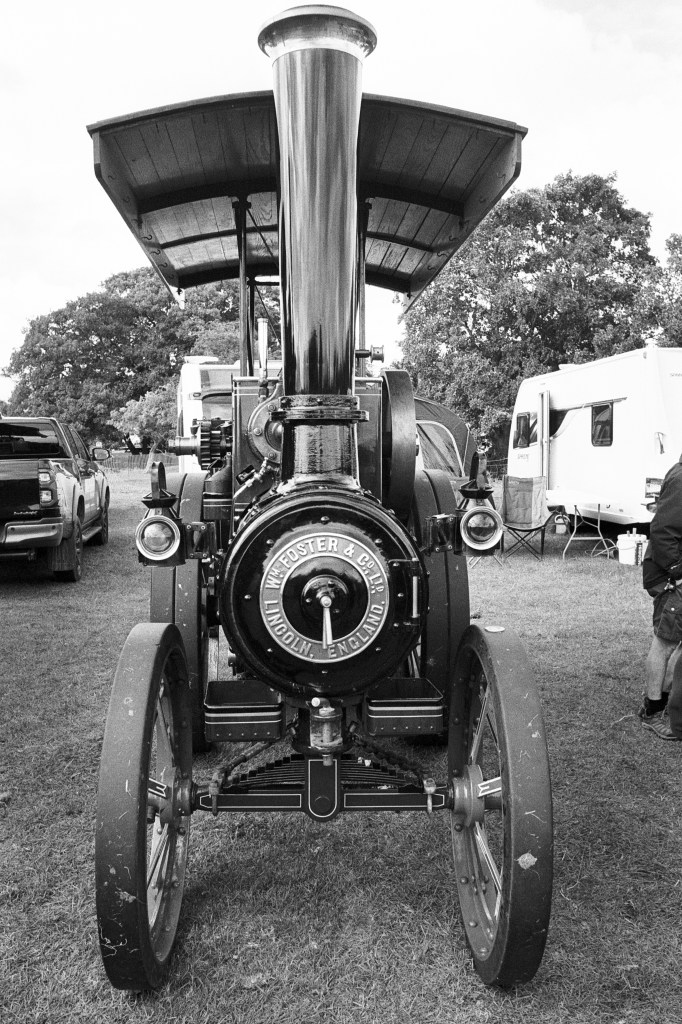
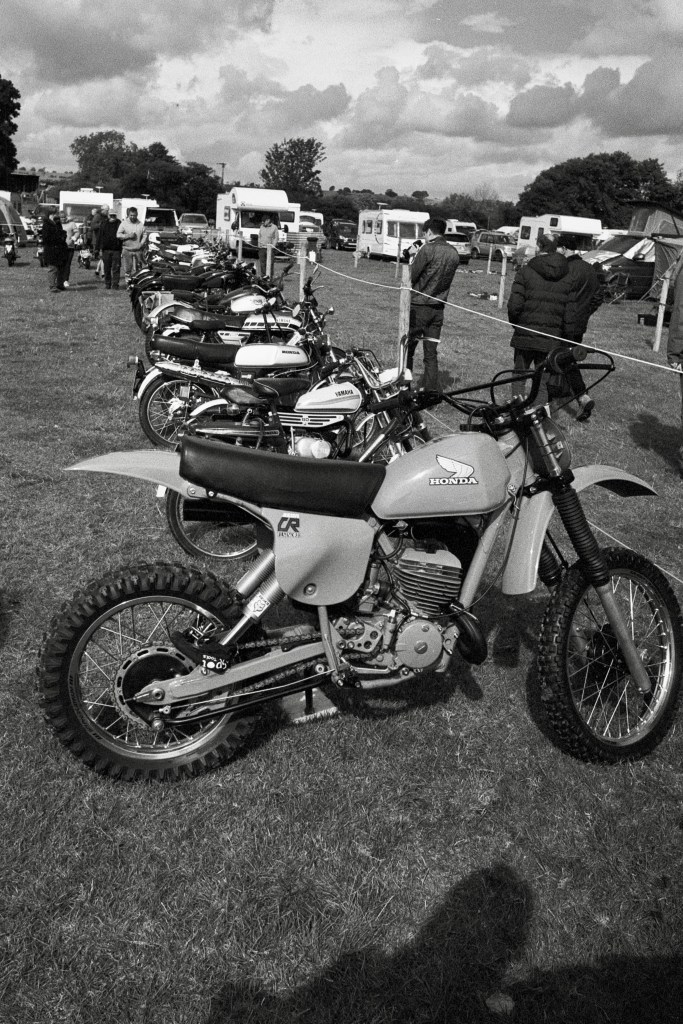

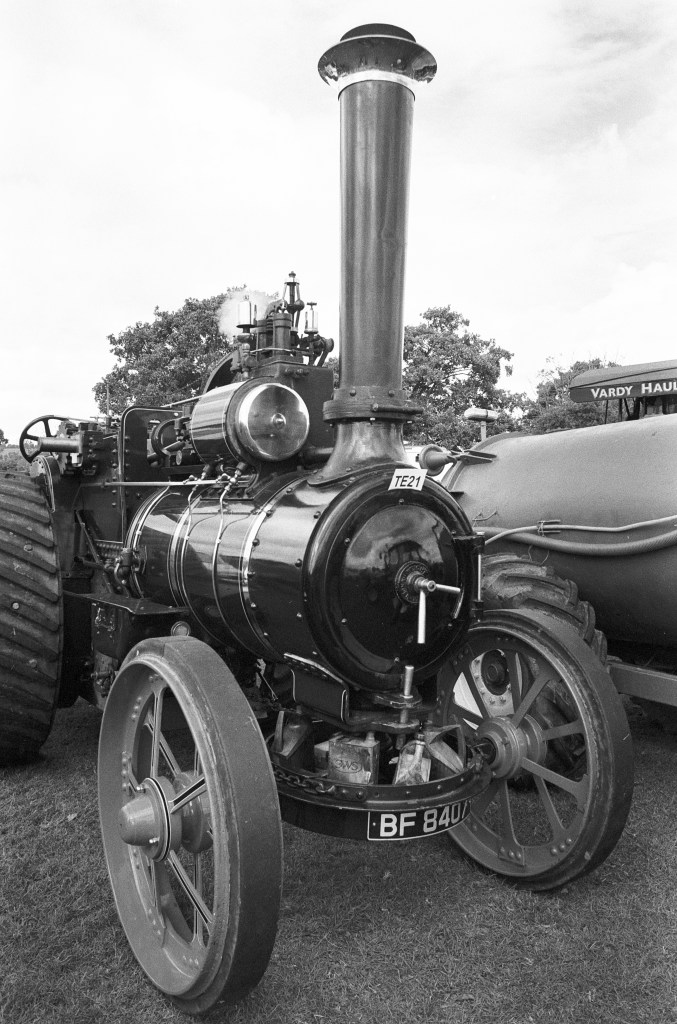
Look for the distortion in the images—this is a common outcome when using 28mm lenses at a fairly close distance to the subject. There’s nothing inherently wrong with the result, but some viewers might dislike the effect. If you examine every photo, you’ll observe some degree of distortion. The Nikkor 28mm f/3.5 is an affordable lens; I paid £65.00 for mine. The contrast and sharpness are excellent, especially considering the use of fairly grainy film. The high acutance of the dilute ID11 developer greatly enhances sharpness, and the compensating effect of the dilution delivers impressive latitude. The image of the Atkinson lorry, TUE 416N, was taken just as it started to rain—if you look closely, you can see a raindrop on the lens. I have no hesitation using my cameras in the rain!
Let’s consider some landscape images:


We consider some random images. Both the steam-driven engines speak for themselves—they are large machines from a different era, cherished by their owners, who are becoming a rare breed. One owner told me he was struggling to find anyone interested in the engines, as they are expensive to run and maintain. At my next steam fair visit, I plan to focus fully on photography and recording interviews. The old, tired Chevrolet presents a real challenge for any potential restorer. It’s a nice pickup but requires absolute dedication. The Volvo F86 truck holds personal interest for me; I drove one for many thousands of miles, and this particular example is in immaculate condition. While it didn’t revive many fond memories, I would have liked to have driven it!


Conclusion
The reader is presented with a well-documented account of a vintage steam rally. I shot 36 frames of HP5 Plus and 20 frames of Kodak Pro Image 100 color film (the latter to be discussed another time). As shown in the contact sheet, the Nikon FE with a 28mm f/3.5 lens yielded excellent negatives, successfully capturing the essence of the Hunton Vintage Rally. Every negative could be easily printed and would yeild sharp 12 X 9 inch prints. Could the results have been better? Absolutely—if the weather had cooperated and I’d brought the 85mm Nikkor, it could have easily turned into a five- or six-roll day. As noted before, my next visit will focus on producing a full documentary.


The Contact Sheet

The contact sheet reveals a great range of correctly exposed and developed negatives. Although frames 9 and 10 are a little thin, you can see with the scan of the Metisse motorbike (frame 9) that it provided a good scan and would be fairly easy to print in the darkroom.
This concludes the essay on the Hunton Steam Fair. While it may not feature images that appeal to everyone, I am confident that readers of the 35mm Work Book will find plenty of valuable information to help them adopt the straightforward approach discussed in the book.
 The Heart of the Mind