The central focus is the question, ‘How Light Can You Travel?’ I’ll wander while exploring the question, never writing about how or why from a definitive viewpoint. The reader is asked to consider the essay a writing exercise, nothing more, and there is a bonus if they gain insight or valuable information. I don’t conform to written rules or sheep-like methodology. There is no care if an opinion is right or wrong, either mine or others. If something is thought-provoking, we know the brain is reasoning and not stagnant.
Listen to the audio recording of this article. The recording was made using the equipment and software mentioned in this post.
How Light Can You Travel?
How Far Can You Go?
I’m writing this post after a recent visit to America. I took a minimum of writing and picture-recording equipment. I wondered how little recording equipment I would need to carry and still be able to produce a good WordPress article while travelling. I also use a film camera to photograph certain subjects, which would influence the idea of travelling with as little equipment as possible.
Many years ago, I knew someone who had a permanently packed bag. He desired to have immediately available baggage for travel anywhere, anytime—pick up the bag and go. He never fulfilled the plan in the years I knew him, but the idea is sound. I want a permanently packed Billingham bag with my recording kit to travel light and go far…
I’m writing this weblog using the minimal equipment listed below. Indeed, this post, images, and recordings were all made with the equipment. The idea of minimalist travel has been explored many times before. This post is only one set of ideas; hopefully, it could be a seed of thought for others to explore.
List
iPhone 15 ProMax
Folding keyboard
Folding phone stand
Shure MV88+ Microphone kit
Canon 2d2 camera – Voightlander 50mm f3.5
Fomapan 100 film
Billingham bag
I want to add an iPad Pro or MacBook Air to the list, but there has to be a cutoff point.
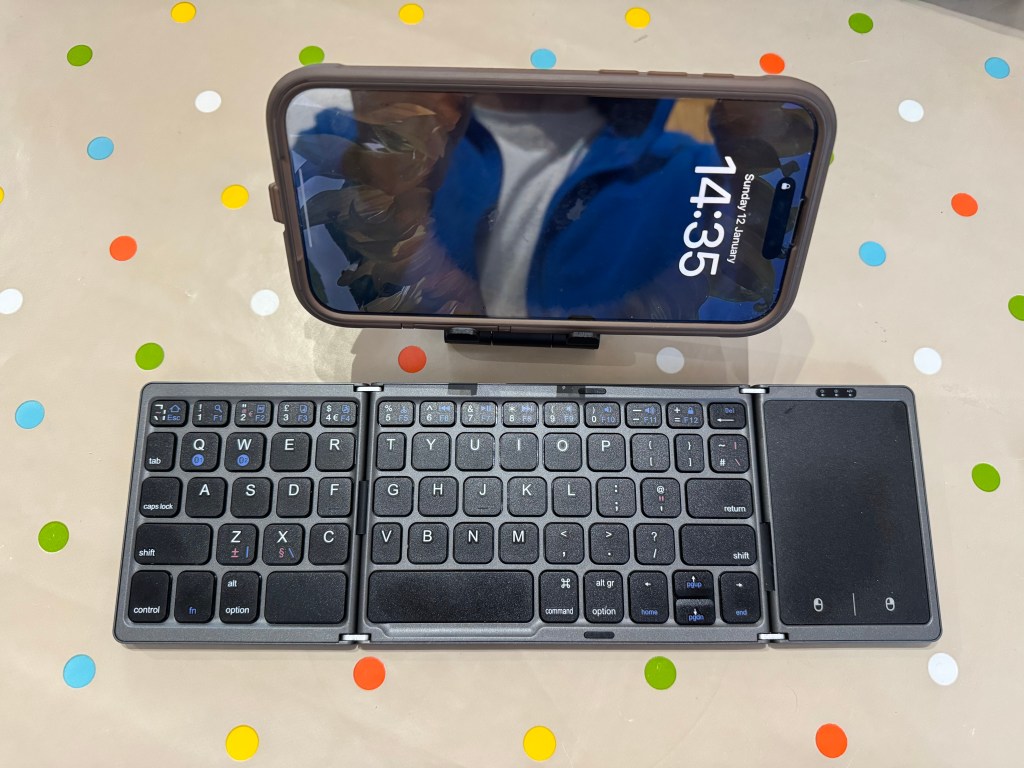
Folding Keypad ~ Stand ~ iPhone ~ The Operation Centre
I’ve concluded that for images used on weblogs or the internet, there is little point in using anything other than an up-to-date phone camera. If you’re a high-quality camera nut and disagree, please track me down and lynch me. Put me out of your misery! What is the point of carrying a megapixel camera if you are not recording for magazines or media companies? And from my perspective, carrying the camera opposes the sentiment of the ‘travelling light’ idea. Ok, the concept is already flawed. The film camera is the elephant in the Billingham bag!
I have often suggested that the phone camera is equal to most (if not all) 35mm analogue film cameras. From my perspective, film is limited regardless of the lens or camera. It will record more artistically, but the film has a limited exposure latitude issue that the modern iPhone (and Android) will whip to death. I agree; many analogue cameras have incredible light meters, but traditional film does not have the latitude to bring home super images every time. I read many articles written by modern-day experts about analogue camera use, and rarely, if ever, do they write about exposure bracketing. This technique involved the photographer taking an exposure reading of his subject and then taking a series of images exposing the subject with f-stop or shutter speed changes on either side of the original reading. As a professional photographer who used film, I write without hesitation and with accuracy; for every vital assignment, I bracketed exposure for every critical subject to be sure a well-exposed frame would be available. Of course, I used the camera’s meter for journalistic work, which was always set to aperture priority. The film was always overdeveloped to ensure images of the emulsion. It is of interest to monochrome film users who seek the photojournalistic look of the heydays of newspapers. If you desire to reproduce the style, over-develop the film by 40%! After a review of the results, you will be very near the desired newspaper style image.
So why do I wish to carry a film camera? The simple answer is that I love the imagery; I love the grain, the possibility of failure, and the nostalgia. I’m not interested in the financial expense of the process. I love the slow nonsense of the whole process compared to the fast-running, need-everything-yesterday approach to life.
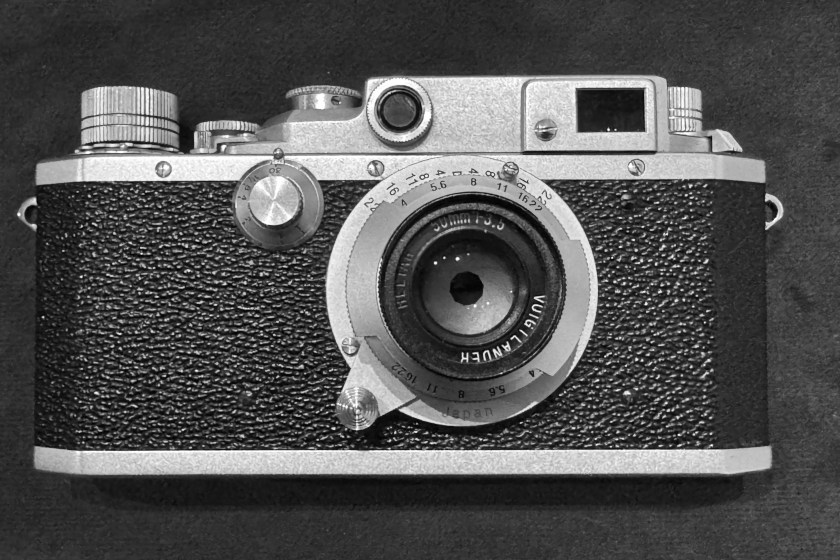
Canon 2d2 with the amazing Voightlander 50mm f3.5 101 years anniversary lens
When I write of failure, all who use a film camera know the feeling of great expectation of a series of exposures taken of a subject, only to be disappointed that what we saw was either lost through error or did not make the mark when printed. Analogue snappers enjoy the gamblers’ feeling of chance and reward in exchange for significant stakes. Win some, lose some. That is a film photographer’s lot. And like life, the more you lose, the better you become. The more you persevere, the sharper the skill.
Do not fool yourself when you see the photographs of great image-takers. They expose many frames from many angles, using more than one lens. So-called genius, defining moments, and the like are chances in time captured at a fluke split second. This is why anyone who uses his phone as the primary image recorder, takes plenty of shots, looks at the images carefully, and uses basic editing software to change the image from ‘snap’ to interesting will become a better analogue photographer.
Recording ‘sound bites’ and ‘Vox Pops’ is also worth accompanying your work. The phone recorder is a fantastic tool for interviews. If a separate microphone is used, the photojournalist will truly up the game. My Shure 88+ has travelled with me for many years. It is a super, relatively cheap instrument for recording at events or just for my podcasts. The Shure has also become a fantastic video sound recording tool.
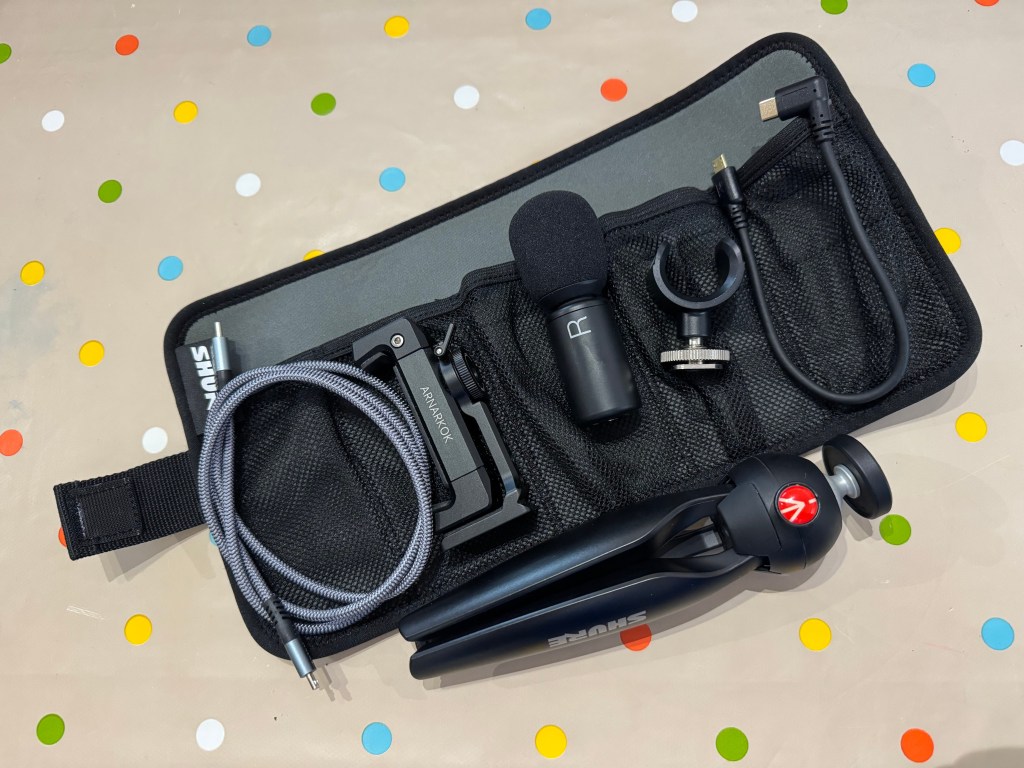
Shure MV88+ ~ The kit contains everything but the USB-micro to USB-c data cable
I choose to utilise the Hindenburg recording software for podcasting or voice recording. I use it for field recording and editing. The pro version has many advantages, including EQ, sound filters, file format conversation and, most importantly, file exchange. A recording can be emailed, drop-boxed, or airdropped with a few taps of the keyboard or screen. The recording of this article was made using Hindenburg software. The process is simple: I open the Hindi field recorder, plug in the microphone and start recording, then I open the Pages app on this iPhone and dictate the script. The file is then saved, and when producing the WordPress post, I add the audio directly from files on the iPhone.
A note about audio accompanying a post
Some time ago, I wrote an article about depression. It was my all-time most significant read article. The written word was also recorded, and I’m amazed to discover the recording has been downloaded tens of times! A written word accompanied by an audio recording for anyone wishing to gain traction on their weblog would make sense. WordPress makes it so easy to send an article to iTunes podcasts. Some know iTunes podcasts now provide a transcript of each podcast. Again, if you desire to attain a good presence or even monetise your work, the opportunity to overlap from written to audio is incredible. The more interpolation between media streams, the greater participation.
If you have read this far, you’ll begin to realise the immense potential of writing and documenting on the move. I have used this equipment in my coffee breaks rather than aimlessly scrolling through social media. A businessperson can use WordPress to connect to the customer base. Communication can go as far as the imagination can take ambition. You can quickly expand on your ongoing document when travelling on a plane or train.

Travelling Light
This post was created with this equipment – Both images and audio recording
Taking pages further than sharing knowledge is key to success. I would advocate spending a few days over a post and ramming it with words, images, audio and links to further information. Thoughts can be accompanied by pictures, recordings, drawings, and written notes. I love Geoff Bridges’s website; it does away with font, and the words are in longhand.
While mentioning Geoff Bridges. Have a looksee at this video. Geoff talks about his Widelux Camera work. He has photographed tens of stars and film sets while making films. He is also working on a project to produce a brand-new Wideluxx Camera (correct spelling) using modern technology. The video is well-aligned with this article.
Consider being brave with the presentation and do not worry too much about ‘grammar nazis’. Be creative. Many criticised Jack Kerouac’s writing style and deemed it unintelligible; the moment a New York Times critic wrote it was the work of genius, guess what? So Jack became a genius, too!
Jack travelled light. On the Road is a masterwork in early travel documentation. Bruce Chatwin also connected travel with stories. Some feel some of his encounters were exaggerated fiction; who cares? Bruces’ writing is enjoyable. Incidentally, his photography was excellent as well.
The mention of Bruce and Jack provides a good ending to this essay on ‘travelling light.’ All who knew Jack commented that he was always scribbling in journals and notebooks. Bruce was the same; his association with the Moleskine notebook is undisputed. Bruce carried the best travel camera of his day: a Leica CL with the 40mm Summicron. I wonder if Jack and Bruce would be webloggers.
To my mind the answer is ‘Yes.’
 The Heart of the Mind