Buying? Buy Smart!
Do photographers focus too much on the quality of a camera and lens? For example, millions of words are written about lens sharpness, vignetting, and all sorts of nonsense about why you should buy a particular brand. I know many will disagree, and they have their opinions; I’m not trying to change anyone’s mind. The point here is that photographers, especially those new to analogue photography, should avoid becoming indoctrinated into believing that one brand of camera is vastly superior to another.
And then there are the comparisons! Where several lenses of the same focal length are pitted against each other. This is truly a pointless exercise. It’s like lining up your friends to determine the outright winner. Moreover, some will insist to their last breath that the German masterpiece surpasses any Japanese mass-produced model. It’s futile and pointless. I beg you, as a beginner, not to go down that path; you’ll find yourself in a wormhole full of vipers and dead-end passages.
It is tempting to think one must own a Nikon, Contax or aspire to a Leica after reading the opinions and reviews of online experts. And do not believe that I am suggesting there are not many competent and knowledgeable people writing very insightful essays about cameras and lenses, because some excellent articles are indeed worth considering.
My point is that many people are too exacting and nitpicky. A lens doesn’t need to be razor-sharp. It doesn’t have to be sharp at the outer edges when used at a wide aperture. Lenses can suffer from barrel distortion or pin cushioning and still be useful in the camera bag. Nor does a lens or camera need to look like it just came out of the box. Often, well-used cameras are more reliable than the unused, mint-condition ones that have solidified grease and vapourised oil within their mechanisms.
In The 35mm Workbook, many affordable cameras are reviewed, and the results are impressive. The review of the Cosmic Symbol shows how a £9.00 camera can truly produce striking photographs.
Let’s consider, for a moment, William Eugene Smith. He is regarded by many as the most influential documentary photographer. His work spans every subject, from war and English general elections to industrial poisoning, and a two-year project documenting Pittsburgh steelworkers, during which 13,000 negatives were exposed! Eugene Smith is perhaps the most notable 35mm camera user of all time. If you search for the cameras he used, you’ll discover he employed any make, any model. Mainly, he used 20mm, 24mm, 35mm, 50mm, and 85mm lenses. The reason for his varied camera choices was often financial hardship, leading him to pawn or sell his cameras to stay solvent. This meant that for any assignment, he used whatever gear he could find. Some say he preferred Contax, Leica, or Nikon! As you can see, even experts dispute his ultimate preference. Those who truly know understand he didn’t care about the camera; he took many photographs. Some of which became historically significant documents.
Those who read about Eugene Smith know his work surpasses any make of camera. The key lesson here is the most important thing we can learn when starting in artistic and creative photography. The goal is to buy what you can easily afford, rather than aspiring to a specific camera or lens, and to focus on capturing and creating great photographs.
First Camera?
In the early stages of your photographic journey, I’d recommend not spending too much money on a camera. The Olympus Trip 35 could meet almost all of the initial needs. After using its auto-exposure and learning about zone focus for a while, you’ll start to get the hang of analogue photography, or perhaps even question its relevance. If the bug bites you, you can then explore the possibilities available. Really consider your budget; never overstretch your finances for a hobby, or it will soon become a millstone.
Eventually, you’ll have read thousands of words about cameras and techniques, and then a decision must be made. What camera and lens? I’m not going to write about this here! I’m writing about setting the mind into the ‘Buy Smart’ attitude.
Some readers may be interested in my preferences, but I have none. What has happened is that the cameras I use are part of an evolution, and I am very aware of how much my 35mm equipment costs, preferring to buy and use film rather than owning tens of seriously expensive cameras and lenses. When I travel on my motorcycle, my camera is a Nikonos III. The film I choose is either Kodak Pro Image 100 or Ilford FP4 Plus; I switch between monochrome and colour. I mainly use ‘Sunny 16’ for exposure measurements or the MyLightMeter Pro app if I want a more accurate assessment of the lighting.

Nikonos III
When travelling in my pickup, I carry a bag containing two Nikon FEs (not FE2) and a Nikon FM. It includes three Nikkor lenses: 28mm f/3.5, 50mm f/2.0, and 85mm f/1.8. Two filters, yellow and orange. Lens caps, lens hoods, film, batteries, an old Weston EuroMaster meter and lens cloths. When I start my day’s photography, I usually take one camera body, attach the 50mm lens, and put the 28mm lens in my pocket along with the filters and a few rolls of monochrome film. If I feel colour images are needed, I load one of the spare bodies with Kodak Pro Image and take this along for the day’s work. That is it! No other choices are made or needed.

Contents of Camera Bag

The 28mm is attached to the Nikon FE, and normally I’ll choose the 50mm on the right for the second lens unless I expect to photograph people, then I’ll carry the 85mm.
Buying Cameras
Buying cameras takes patience. I check eBay daily to follow market values. I look at buy-it-now prices. Many listings allow for making offers, and if I were to buy a camera, I would suggest offering 10% less than the asking price. There is a fairly long article about buying cameras in the 35mm Work Book.
Note that I have three cameras of nearly the same type. The original FE and FM cameras do not possess the same features as the later versions; however, this is of little importance in real-world photography: these models are much cheaper to buy. I always planned to purchase a good camera and have it serviced over time. In other words, I now own a few cameras that will last for many years. And I have no intention of buying any more camera bodies.
I follow a similar approach with lenses:
Lenses can be purchased in the same manner. I do not worry about the speed of the lens. F/3.5 is more than adequate for most wide-angle photography, especially if you use faster film. And f/2.0 has been more than sufficient for all of my work over the past fifty years. The smaller aperture lenses offer great value for money and, once cleaned, lubricated, and adjusted, will last for many years. I own serviced fast lenses but prefer the lighter weight of the ‘lesser’ versions. I continue to search for well-priced lenses of the make I now use, recently acquiring another 28mm f/3.5 Nikkor with UV filter and specific lens hood for only £65, including postage. In time, this will be cleaned, lubricated, and adjusted. Not a colossal investment for a lens in mint condition. And my only purchase for many months. Lenses are rarer than bodies!
The cameras cost:
FM – £78.00
FE – £76.00
FE – £85.00
Typical Prices Paid for Lenses:
28mm f/3.5 – £75.00
50mm H f2.0 – £45 approx
85mm f/1.8- £85
So, the total cost was approximately (the 50mm H Nikkors are usually purchased with a Nikkormat!) £464.00, and these cameras and lenses will not be replaced; they are my ‘go-to’ choices. If we simplify the setup and remove the two lower-priced cameras from the equation, the total cost would be £ 310 for one camera body and three lenses. Some people would spend this amount on a camera body. Any photographer could easily use this small setup to produce fantastic images and cover at least 95% of all photographic situations. It is the photography and techniques that make a great artistic or creative photographer, not the equipment. Eugen Smith knew this, and if the premise is good enough for him, I’m happy to follow!
So, the message is to aim for great pictures, not expensive equipment! If you are wealthy or your credit card can handle the expense, go ahead and make the dealers rich; they will only be too happy to sell you your heart’s desire. Be warned, though, collecting cameras can soon become an addiction, and for many people, the addiction becomes greater than the need to take pictures.
Overview
• The text questions the emphasis on camera and lens quality in photography, especially for beginners.
Emphasis on Quality
• Many photographers obsess over sharpness and brand reputation.
• Beginners should not feel pressured to choose high-end brands like Nikon or Leica. There are plenty of camera and lens bargains made by Pentax, Canon, Yashica, Minolta, or Praktica.
Comparisons Are Futile
• Comparing lenses is compared to pointless competitions
• Such comparisons can cause beginners to become confused and develop misguided preferences.
Practical Advice
• A lens doesn’t need to be perfectly sharp; imperfections are acceptable.
• Well-used cameras often perform better than those in mint condition.
Case Study: William Eugene Smith
• Smith, a renowned documentary photographer, used various cameras regardless of the brand.
• His priority was on capturing excellent images rather than the quality of his equipment.
Personal Equipment Choices
• The author prefers affordable gear and values practicality over brand prestige.
• Example setup includes:
• Nikon FE
• Three Nikkor lenses (28mm, 50mm, 85mm)
• Total cost is around £300
Conclusion
• Strive to create great photographs instead of investing in many items of expensive gear that remain unused.
• Collecting cameras might become an addiction, diverting attention from the true goal of photography.
Note:
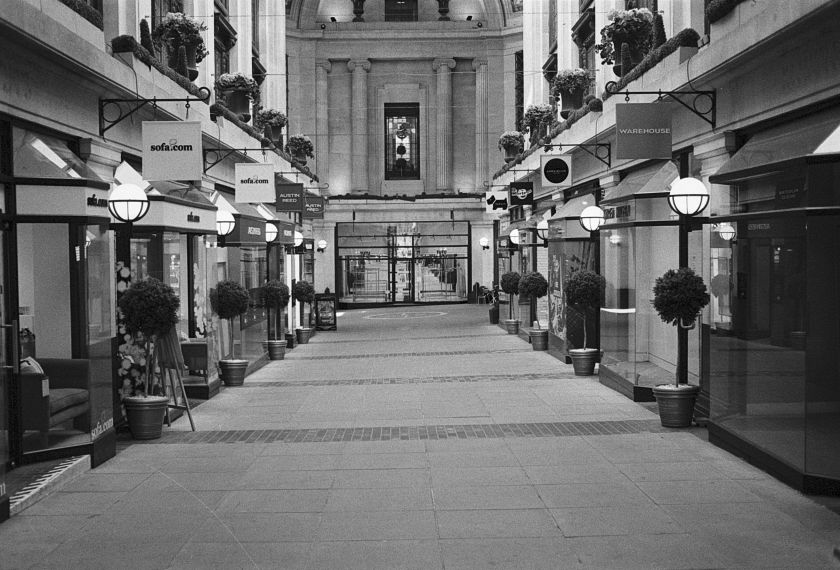
The cover image was taken the day after the complete lockdown in Nottingham – HP5 Plus, Pentax MX, 40mm Pancake Lens.
 The Heart of the Mind